










From Vingt-et-Un to Las Vegas: The Fascinating History of Blackjack
Last update: 10 Mar 2026, 11:41
Some casino games have captured the global imagination quite like blackjack. Known for its blend of simplicity and strategy, blackjack has become a staple in both glamorous casinos and casual home games. Yet behind this seemingly simple game lies a centuries-long history filled with cultural evolution, mathematical innovation, and tales of high-stakes drama. From the 17th-century French casino to Las Vegas tables, and now to the digital screens, blackjack’s journey is as rich and riveting as the game itself.
In this article, we explore the fascinating evolution of blackjack, how it was born, transformed, and popularised, ultimately becoming one of the most enduring and beloved card games with a rich history worldwide.
History of Blackjack: The Birth
Long before it was known as blackjack, the game existed in various forms throughout Europe. Its origins are traced back to France in the 1600s, but similar games were being played in Spain, Italy, and Britain, each influencing the development of the modern version.
At their core, these early versions centred on achieving a target numerical value using a deck of cards, typically 21 or 31. The rules and names varied, but the foundational thrill of chance, skill, and calculation was always present. Cultural preferences and regional innovations played a crucial role in the game’s spread and evolution across the continent.
Vingt-et-Un in France
The most obvious ancestor of modern blackjack is Vingt-et-Un (twenty-one), which appeared in French casinos in the early 1700s. Influenced by games like Chemin de Fer and Ferme, Vingt-et-Un involved a dealer and several players who aimed to reach 21 points without busting.
Key features of the game included:
- The dealer has a strategic advantage by playing last.
- Players are allowed to double their bet in certain situations.
- No concept of a “blackjack” bonus as we know today.
This version established several of the structural elements we now associate with blackjack and laid the groundwork for further developments once it crossed borders.
Spanish and British Influences
Around the same period, Spain had its own variation called One and Thirty (Trenta y Una), where players aimed for 31 points using three cards, often within a single suit. Meanwhile, in England, card games like Bone Ace and Pontoon (an early form of blackjack still played in Britain) were gaining popularity.
These games introduced ideas, such as flexible rules for drawing cards, special bonuses, and different hand values, many of which would influence blackjack’s adaptation in the Americas.
Blackjack Comes to America
Blackjack made its way to North America during the 18th century through French colonists, particularly in regions such as New Orleans, where French gambling customs took root. Known initially as Vingt-et-Un, the game retained many of its original rules, but as it spread westward across the United States, it underwent notable transformations. The absence of standardised regulations allowed local gambling houses and saloons to tailor the gameplay to suit their clientele, often adjusting the rules to make the game faster, more exciting, or more profitable for the house.
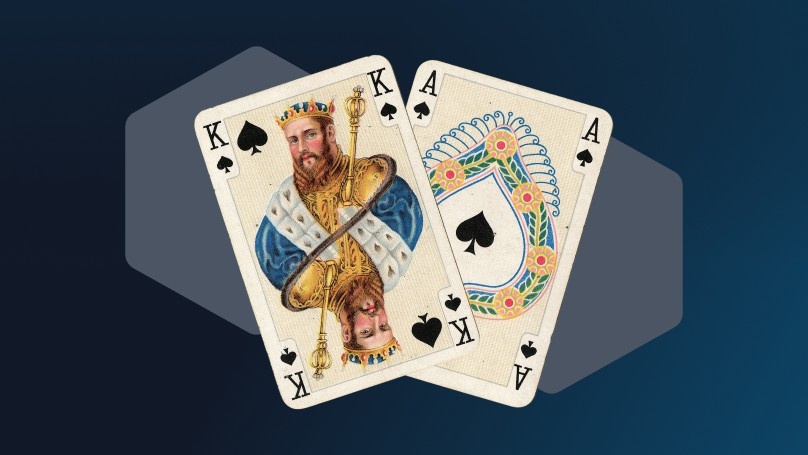
In an attempt to boost the game’s popularity in early 20th-century American gambling halls, operators devised marketing gimmicks. One of the most effective strategies was offering a special payout, a 10-to-1 bonus, if a player’s hand consisted of the Ace of Spades and a Blackjack (either the Jack of Spades or the Jack of Clubs). This promotional twist aimed to draw attention to the game amid a sea of other gambling options. Although the bonus didn’t last, the nickname it inspired did. From then on, Vingt-et-Un was commonly referred to as “blackjack.”
As Nevada legalised gambling in 1931, blackjack rapidly became a fixture in Las Vegas casinos, with standardised rules and evolving strategies helping to shape the modern version we know today.
Evolution of the Rules and Gameplay
As blackjack gained popularity, especially in Las Vegas casinos after gambling was legalised in Nevada in the 20th century, the game underwent significant rule changes to standardise gameplay:
Dealers must hit on 16 and stand on 17: A universal house rule for consistency.
Doubling down and splitting: Introduced to create more strategic options for players.
Use of multiple decks: Casinos began using four, six, or even eight decks to deter card counters.
Insurance and side bets: Developed to increase excitement and profit margins.
These changes not only streamlined the game but also added layers of strategic depth, making blackjack a cornerstone of the casino.
The Rise of Strategy: Blackjack Meets Mathematics
Unlike purely chance-based games, blackjack’s fixed rules and finite deck made it a candidate for mathematical analysis. By the mid-20th century, both players and academics began to take the game seriously.
This marked a turning point where blackjack was no longer just a game of luck, but it became a game of advantage play, where odds could be tilted in the player’s favour through knowledge and discipline. Statisticians began using early computers to simulate thousands of hands, analysing how different decisions, such as hitting, standing, or splitting, affected outcomes. These studies led to the development of optimal strategy charts, enabling players to make statistically sound choices for every possible hand combination.
As research deepened, players realised that certain conditions, such as a high proportion of face cards remaining in the deck, significantly improved their chances. This insight paved the way for the practice of card counting, where players track the distribution of cards to adjust their bets accordingly. Casinos soon recognised this growing sophistication and responded by altering rules, introducing multiple decks, and closely monitoring players to protect their profits. Blackjack became not just a game but a contest of intellect between a gambler and a house.
Card Counting and Edward Thorp
In 1962, mathematics professor Edward O. Thorp published Beat the Dealer, a groundbreaking book that introduced the world to card counting. Using probability theory and computer simulations, Thorp demonstrated that players could gain a statistical edge over the house by keeping track of the ratio of high to low cards remaining on the deck.
Key contributions:
- The Hi-Lo system is one of the most accessible and effective card-counting methods.
- Public validation of the idea that blackjack could be “beaten.”
- A surge in popularity among serious gamblers and recreational players.
Casinos, in turn, began implementing countermeasures, such as shuffling more frequently and banning known counters.
MIT Blackjack Team and Other Legends
Perhaps the most famous real-world application of Thorp’s theories came in the form of the MIT Blackjack Team. Comprising students and alumni from MIT, Harvard, and other top schools, the team employed advanced card counting, team play, and disguises to win millions from casinos during the 1980s and 1990s. Their story inspired books like “Bringing Down the House” and the Hollywood film “21,” cementing blackjack’s place in pop culture lore.
Blackjack in Pop Culture
Over the decades, blackjack has evolved into more than just a casino game; it has become a cultural icon. Its recurring presence in literature, movies, and television has given it a unique status as both glamorous and intellectually challenging.
Notable appearances:
James Bond playing blackjack in License to Kill.
Rain Man’s card-counting scene brought public attention to the tactic.
Countless scenes in Hollywood thrillers and dramas depict blackjack as a high-stakes mental duel.
Blackjack in the Digital Age
The internet boom in the late 1990s and early 2000s brought blackjack to a global digital audience. Suddenly, anyone with a smartphone or computer could play from anywhere. Today, accessing top blackjack casino sites is just a click away.
Developments include:
RNG (random number generator) games: Software-based blackjack ensuring fairness.
Live Dealer Blackjack: Streaming real human dealers to players in real-time, bridging online and land-based experiences.
Mobile Apps and Strategy Trainers: Making blackjack accessible and learnable for players at all levels.
This digital revolution has ensured that blackjack remains relevant and widely played, even beyond the walls of traditional casinos.
Global Popularity and Blackjack Tournaments
Today, blackjack is a fixture in nearly every major casino worldwide, from Monte Carlo to Macau. It’s also a competitive game, with structured tournaments attracting top talent and serious prize money.
Global Variants
Different regions have developed their own rule sets and nuances:
- American blackjack: Dealer receives one card face-up and one face-down; players can peek for blackjack.
- European blackjack: Dealer receives only one card until all players have completed their hands.
- Pontoon and Spanish 21: Add unique twists like different payout schemes and card rules.
These variants enable cultural customisation while preserving the game’s core thrill.
Tournaments and Competitive Play
Blackjack tournaments offer players a chance to compete for large sums while playing against each other rather than the house. The World Series of Blackjack and other televised events have contributed to the appeal of blackjack as a skill-based, competitive game.
Features of tournament play:
- Players start with equal chips.
- Betting strategy and chip management are as crucial as card play.
- Final tables bring tension, excitement, and big rewards.
Final Thoughts on Blackjack
From its aristocratic roots in 17th-century France to the neon lights of Las Vegas and online casinos, blackjack has undergone an extraordinary transformation. Along the way, it has absorbed diverse cultural influences, inspired mathematical revolutions, and given rise to legendary figures who tested the boundaries of probability and nerve.
What makes blackjack truly timeless is its perfect balance: easy to learn, hard to master. Whether you’re a curious beginner, a calculating strategist, a skilled dealer, or just someone looking for entertainment, blackjack offers a universe of intrigue within a simple deck of cards. It’s no wonder this iconic and thrilling game continues to captivate the world, generation after generation.